

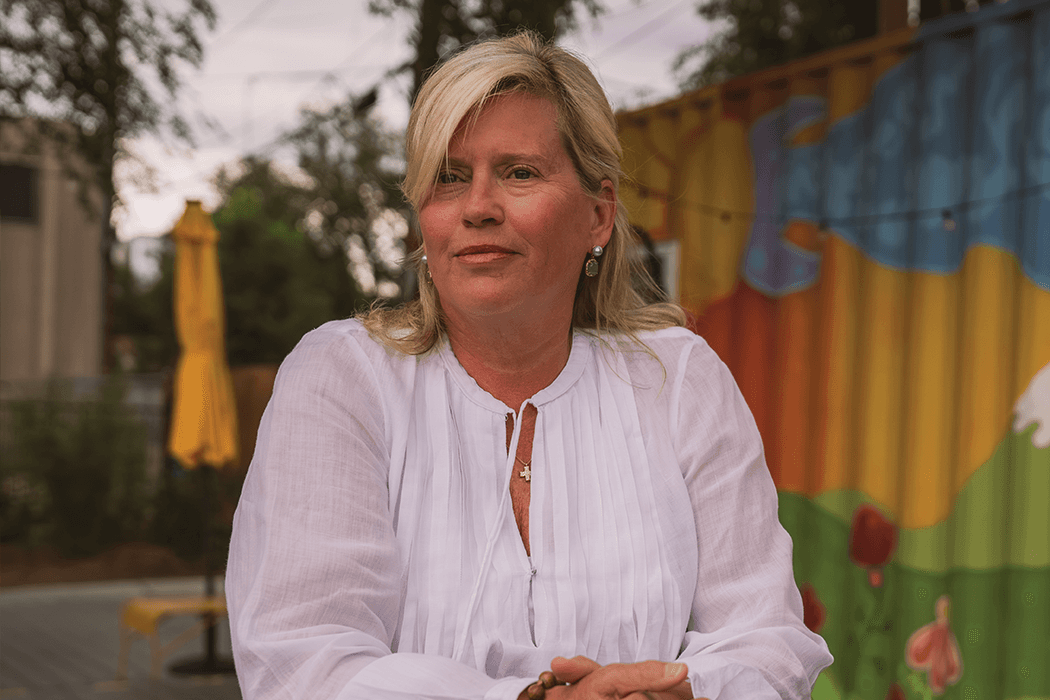
Shelley Jensen is building villages where safe housing, life skills and belonging open doors to resilience and hope.
- Words
- Josh Skaggs
- Photos
- Ernest Bordon
- Read
- 4 min
- From the issue
- Issue 162
In 2015, a Harvard report examined key differences in outcomes for children who grew up in trauma. They found that one factor differentiated those who developed resilience and succeeded from those who did not — the presence of a committed, caring adult.
“Humanity is our common denominator,” Shelley Jensen said. A belief in the power of human interaction is behind all her work as the founder of We Fortify. A team of “social impact community builders,” We Fortify builds homes and creates programs for people who need safe, affordable housing. Their first village, Working Fusion, was built in 2022. This village is currently home to 18 residents aged 18-25.
When Shelley describes the trauma these residents have survived, she uses the metaphor of a tunnel filled with fog. Many of them have experienced extreme neglect, physical abuse, sexual assault or other forms of harm. Serious trauma often reduces a person’s perspective to the present moment as survival becomes the primary goal. A person’s vision constricts to the next step in front of them.
We Fortify offers a landing place where its residents find the safety required to expand their vision beyond survival. They do this by offering therapy as well as coaching, including a 12-unit life skills curriculum taught by outside consultants. Additionally, a staff member meets with each resident on a weekly basis to check in on their empowerment plan and track long and short-term goals. By the time residents move out, Shelley hopes they have become more financially stable, socially connected and able to make long-term decisions for a good future.
“I love building homes for people and having them be safe,” Shelley said. “My hope for every resident is that they get through the tunnel of fog.” Five years in, more and more people are finding their way through the fog, and Shelley has bigger dreams than ever. She mentions plans to offer wilderness therapy for young men or a dating app that connects donors to projects that need funding. She might also mention moving from tiny homes to a modular build to increase housing capacity and decrease construction time for future villages.
For her, these are not pipe dreams. Shelley has a track record for moving dreams into reality.
“I have the brain of a capitalist but the heart of a social worker,” she said. We Fortify was created from that duality. After witnessing a close friend of hers evicted from her home due to circumstances beyond her control, Shelley wanted to start a business that would support people in housing crisis. Through several conversations and paradigm shifts, she realized that she was starting a nonprofit.
Then COVID hit, and everything ground to a halt. “I almost quit,” Shelley remembered.
A proposal for the first We Fortify village had already passed unanimously through city council twice, but government funding was now being designated to salvage existing nonprofits rather than starting new ones. Shelley applied for a grant with the El Pomar Foundation, which told her to come back when she had more backers. With a sliver of hope because “They didn’t say no,” she developed an expedited funding plan she called her “accelerator model.” The Etson Foundation fully funded the first home and other investors started coming onboard. When she returned to El Pomar, they released funds for operations and infrastructure.
The first village, Working Fusion, has been in operation for three years. A community of homes with raised-bed garden boxes filled with fruits and vegetables, Working Fusion is a safe place for residents to grow and prepare themselves for the future.
We Fortify is also preparing for the future and, like its residents, will need support from a broader community to grow. Shelley believes we need decentralized systems of support, humanizing our neighborhoods. Her funding model relies on donations from partners rather than loans, building a relational network of people who are invested in the vision. This belief is what inspired “The Power of We,” a capital campaign to fund two new villages, both of which have been approved for construction. These villages will rollout the Noble and Elevate Divisions, two distinct branches of We Fortify’s work. The Noble Division will provide housing for people who provide critical support, services and infrastructure for the city: bus drivers, teachers, nurses and others. These villages also provide a modest revenue stream to make We Fortify’s other work more sustainable.
Villages in the Elevate Division, such as the Working Fusion village, host young people who are climbing out of generational cycles of poverty. Each home is fully furnished to its residents’ specifications. Most of these furnishings, the mattresses, washing machines, towels and dishes, will go with the resident when they move out. Villages in the Elevate Division offer a one-to-nine ratio of staff-to-residents, ensuring personal care for each individual.
When asked about this model, Shelley returns to her main point: “Humans are relational.”
We Fortify has been contacted by 19 other states, asking if they could expand their work into other locations. Shelley has turned them down, knowing how important it is to scale with intentionality.
“However, there is such need from this young adult demographic that it also breaks my heart,” she said. “Because we want to prevent future homelessness everywhere.”
Her long-term goal may be to prevent future homelessness everywhere but today you can find her hard at work in our city, building a committed, caring community with an eye toward the future.
“Once you’re in We Fortify, you’re always a part of We Fortify,” she said.
Keep reading

City
The Orphan Who Became Shelter
Shaped by hardship and loss, Jim Daly now leads a global ministry with humility, grace and a heart for vulnerable families.
By Alyssa Shikles5 min read

City
What If...?
From Basketball to Books: D Earls’ Journey Beyond the Court.
By Tiffany Wismer4 min read
City
Invitation to Impact
A transition from military service to business ownership.
By Mac Conn4 min read