


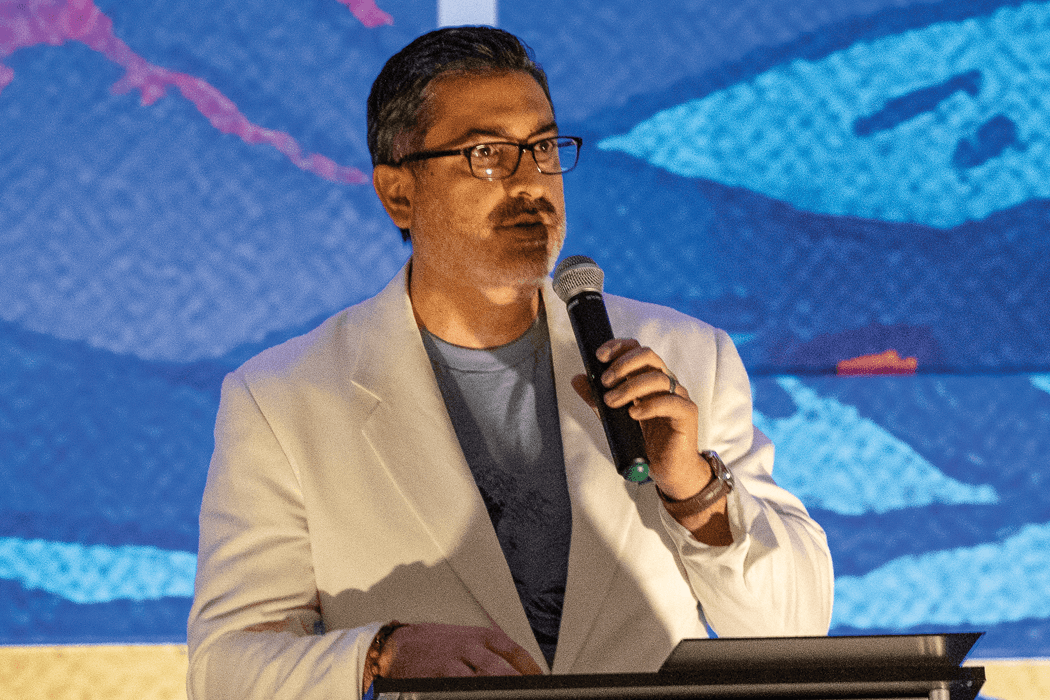
Dr. Reagan Anderson pushes himself to be healthier and encourages everyone to take agency and create their own health.
- Words
- Sarah Tilton
- Photos
- Reagan Anderson
- Read
- 5 min
- From the issue
- Issue 162
Colorado Springs is home to countless state-of-the-art wellness programs, gifted physicians and cutting-edge facilities. Among them is Reagan Anderson, D.O., founder of the Colorado Dermatology Institute. Before becoming a board-certified dermatologist and Fellow of the American Society of Mohs Surgeons, Dr. Anderson served as a decorated combat veteran in the United States Navy. He was a surgeon with the First Reconnaissance Battalion of the Marine Corps and completed two tours of duty in Fallujah, Iraq. Those experiences, marked by courage, precision and a deep respect for human life, continue to shape the way he practices medicine today. They also instilled in him the discipline and resilience he now believes are essential for lasting health, reminding him that the best equipment, training or facilities mean little if people do not take ownership of their own well-being.
According to Dr. Anderson, these resources, as impressive as they are, are not the most important part of the health care equation. You are. Dr. Anderson wants every patient to recognize this truth, take ownership of their choices and create agency in their own lives.
“I got into medicine to, hopefully, help people create the life they wanted. But I don’t think anybody, whether rich or poor, can have the life they truly want if they don’t have health as the foundation,” he explained. That conviction led him to establish Colorado Dermatology Institute, with the goal of transforming health care from the inside out and treating patients as people rather than diseases and instilling a culture of compassionate care, education and mindful action.
This vision frames his broader call for change. For Dr. Anderson, this transformation begins with shifting away from a system of “sick care” towards true health care. “We unquestionably have the best training for physicians in this country. We have the best equipment. From a physician standpoint, the best on the planet. When the ultra-rich want the best care in the world, they come to America. Yet we still have some of the worst health statistics among developed nations.” The paradox, he says, reveals a deeper problem. The system cannot be fixed by equipment or expertise alone.
That conviction leads naturally to the question of responsibility. Many agree that health care is broken but blame often gets cast in all directions like insurance companies, pharmaceutical giants and doctors themselves. For Dr. Anderson, blame is not the answer. The path forward begins with ownership, individuals taking responsibility for their own health. And that requires confronting a cultural tendency toward “quick fixes.” Too often, people skip the basics of health because, as he puts it, “there’s a pill for that.” Yet over 80% of chronic disease is preventable through simple lifestyle modifications such as exercise, eliminating processed foods, eating whole and healthy meals and practicing mindfulness.
Still, Dr. Anderson warns that lifestyle choices cannot be separated from mindset. He connects an underlying current of apathy and inaction permeating our culture to unaddressed mental health concerns and a misplaced sense of entitlement to good health without good habits.
That connection draws attention to the role of mental health itself. He also sees a strong connection between physical inaction and unaddressed mental health struggles. Depression, anxiety, PTSD and other invisible conditions shape how a person feels in the world and whether they act on their own behalf. “We’re stuck in this cogwheel of mental health being the biggest disease that affects humanity. It always has been and always will be,” Dr. Anderson reflected. Health on the inside impacts how we present ourselves outwardly just as much as a scar or blemish on the skin.
With this in mind, Dr. Anderson returns to practical steps anyone can take. So how do we begin to build a new culture of health? Dr. Anderson believes it starts small through mindful choices repeated over time. He suggests researching credible medical resources, watching educational videos and beginning with simple steps like eating healthier meals, walking more often, meditating, seeking a counselor, wearing sunscreen or cutting back on salt. Doctors, he emphasizes, are not the “first resort” but rather partners who build upon the foundation of those common-sense actions.
These ideas extend into his practice philosophy. His mission is not just medical but deeply human. Creating agency in patients and in his staff. “The vast majority of patients want a get-rich-quick scheme for health, which is take a pill, not go out on a walk in this amazing place we get to live or put down the social media,” he said. He trains new physicians and staff to slow down, to remember that patients are not numbers and medical staff are not robots. Most importantly, he asks them and everyone, to consider What is your Why? Knowing that answer, he believes, leads to genuine change.
That sense of agency is also deeply personal. Taking agency goes beyond medical appointments. It means facing hard questions with honesty. If you are overweight, depressed or chronically fatigued, it means looking at what you eat, how much you move and what choices you can change. Health isn’t about what is beyond your control. It’s about what you can control. Choosing whole foods, lifting weights at home, walking around the block, practicing mindfulness. Practicing mindfulness will reduce depression, ease stiffness and restore energy.
And when it comes to courage, mental health support is just as critical. Just as importantly, it means normalizing mental health care. “The harm is not getting help when you need help,” Dr. Anderson emphasized. Doctors themselves are not immune, as they face loss, trauma, stress and heartbreak both inside and outside the clinic. They also experience higher suicide rates than the patients they serve. A healthier culture would encourage everyone, including physicians, to seek the support they need. “Everybody falls down, and everybody should have the freedom to get the help to pull themselves back up. But you have to have the courage to say, ‘I need help. I’m not living my best life.’”
In the end, his message is one of courage and choice. For Dr. Anderson, this courage is at the center of health. “We can do hard things,” he encouraged. And Colorado Springs, with its outdoor clubs, holistic health centers, mental health clinics, healthy restaurants, gyms and breathtaking natural surroundings, offers endless opportunities to take action. Health care, he insists, is not about quick fixes. It’s about writing your own story. “Do you want the red pill or the blue pill?” he asked, invoking The Matrix. The choice is between leaving things as they are, or embracing a new world of ownership, agency and possibility.
Keep reading

City
A World of Flavor
Chef Ricardo Morffin brings a sophisticated Mediterranean restaurant to downtown Colorado Springs. At Latin Social, he aims to redefine what “Latin” means through the experience and soul of his food.
By Laura Lorta5 min read
City
Better Business
The 2025 PRISM Awards
By Molly Wingate6 min read

City
Care Runs Deeper Than Skin
Blending mastery, intuition and heart, Rebecca Johnston shows that true skin care is about soul care and confidence that lasts a lifetime.
By Melanie Sue Hicks, PhD5 min read