

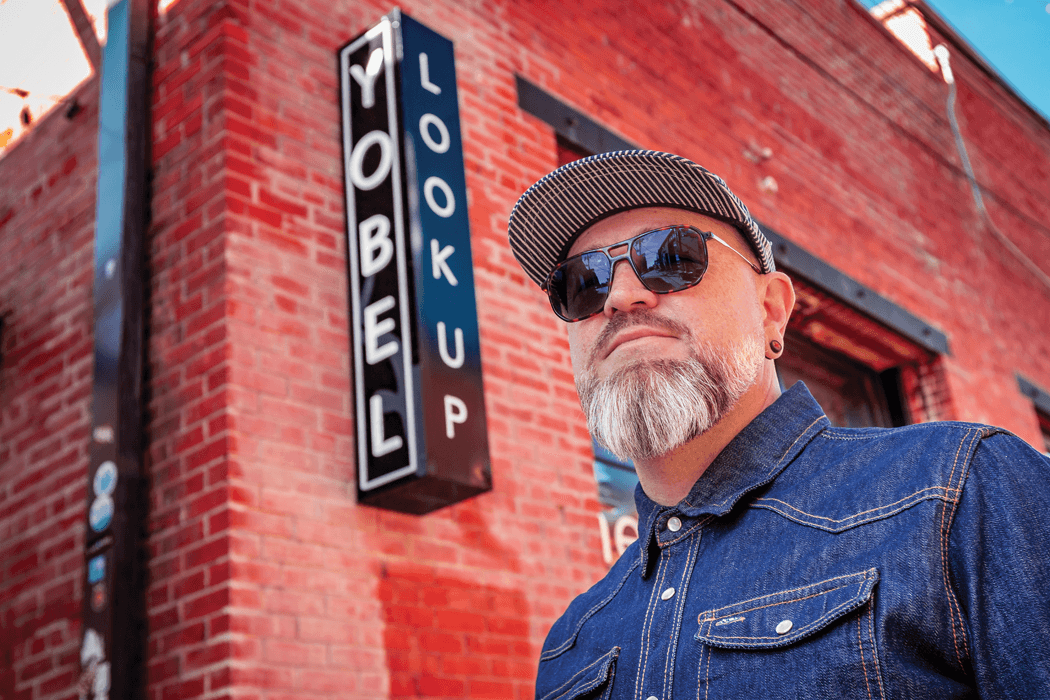
Yobel/The LookUp Gallery provides Clay Ross the space for patrons to come in and find something they love. And, through conversation and shared experience, he hopes they find much more.
- Words
- Pam Bales
- Photos
- Dan Kenemore
- Read
- 6 min
- From the issue
- Issue 164
Love the people in front of you.
A simple philosophy that artist and entrepreneur Clay Ross has embraced daily.
It shows up in small gestures like a bench placed intentionally inside his LookUp Gallery, inviting guests to sit and look. Or a glass of whiskey (from his brother’s Axe & the Oak Distillery) poured for a stranger who wandered into Yobel. It shows up in how he talks about artists as people first, creators second. And finally, it shows up in how he and his wife, Emily, talk about life, their community and business, not as competition, but as a search for win-win situations everywhere.
Clay was born in Alamosa and raised in Colorado Springs, with family roots stretching deep into the San Luis Valley on his father’s side, and Cripple Creek and Colorado Springs on his mother’s side.
The art bug bit Clay early on as a kid; and in junior high and high school, his graffiti roots began.
“Yes, my friend Nate and I would paint in ditches, walls and our neighborhood park basketball court at night,” Clay laughed. We painted that court several times, but the last time was the one I was really proud of. It took me all night and when I went back the next morning to take a photo the city was already sandblasting it off.”
In high school, his art teacher gave him a dedicated corner of the room, built large canvases and allowed him to do his own project. He loved it. Clay, like most kids, dreamed about leaving home after high school and fantasized about a New York City studio where he could live and create, with lots of concrete and spilled paint everywhere.
Those dreams briefly felt within reach when Clay received a significant scholarship to attend art school in Savannah, Georgia. But reality crept in quickly. The scholarship barely covered tuition, leaving housing, supplies and basic living expenses far out of reach. So, Clay adjusted course and accepted another scholarship at Pikes Peak Community College.
That pivot brought its own challenges. Clay took several art classes there. One teacher told him to stop using his imagination. Others told him where to go in town to see “real art” consisting of paintings and photos of Pikes Peak, wolves and Garden of the Gods.
“If that’s art, I don’t want to be an artist,” he remembered.
Those moments didn’t defeat him, but they did redirect him.
Clay went to school for massage therapy, then stumbled into his first career at Community Outreach working with adults with disabilities.
Through that work, he witnessed a recurring and troubling gap when individuals turned 21 — the services and support they relied on often disappeared overnight. Clay helped create a transition program to bridge the gap between high school and adult services. This was his new passion.
Art never disappeared.
“Art has always had a way of finding me.”
He had a few commissions here and there requested by people who saw something in his work before he fully saw it himself.
“I didn’t have angst about not fully pursuing art during that time,” Clay explained. “I loved being a dad and enjoyed life and the work I was doing.”
If there is one role Clay claims without hesitation, it’s that of father. “The only thing I ever wanted to be in life was a dad,” he said.
He has three children, Carter (22), Noah (20) and Graycee (17). Clay believes parenting isn’t about having all the answers so much as refusing to disappear when things get uncomfortable. He lights up when he talks about his kids’ victories and is proud that they are good humans.
Clay’s vocational path continued to evolve. He became a youth pastor, helped plant a couple of churches, worked at Urban Peak, the local shelter for unhoused teens and leaned fully into the work of building community, guiding young people and holding space for difficult conversations.
“At every stage,” Clay emphasized, “I was just loving the people in front of me and moving forward.”
Emily, his wife and business partner of more than eight years, is central to everything, including Clay’s art. Clay describes them as cheerleaders and champions for each other and for their community.
Their first date was at Axe and the Oak Distillery, his brother’s place in Ivywild School. Six months later, they were married in the Ivywild School gym, just across the hall from Yobel. In 2019, they proudly purchased Yobel — pronounced yo-BELL — which was located at Ivywild School.
“We bought Yobel from our dear friend and co-founder Sarah Ray,” Clay explained. “We were both working other jobs and running Yobel on the side when COVID hit. Ivywild closed for an entire year, so we had to pivot and fast-forward our five-year plan and moved to a larger brick-and-mortar downtown. We added head-to-toe men’s and women’s ethical fashion in addition to the accessories that Yobel previously offered.”
Yobel is a Hebrew word for jubilee, meaning freedom. For Clay and Emily, that rings true. Their store offers ethically made products from more than 60 global artisans and companies who provide dignified work, livable wages and safe working conditions. Fair wages reduce exploitation, interrupt cycles of poverty and promote agency over one’s own life and freedom.
“There are, on average, 70 million garment workers worldwide and only 2% of those workers are paid a living wage,” Clay stated. “We want to contribute to growing that percentage.”
Yobel is built on a simple but challenging premise: everyone can win. They believe that “when people and our planet are priority, we all profit,” which is proudly stated in their logo as “People. Planet. Profit.” Clay is quick to point out how radical that idea can feel in a culture trained to expect discounts, BOGOs and Black Friday pricing.
“We want people to come in and fall in love with something,” Clay pointed out. “And then we want to tell them the story of the people who made it.” Art, meanwhile, was calling again.
In 2022, Clay and Emily launched The LookUp Gallery inside the new Yobel space. Artwork was mounted intentionally at an angle above the clothing, inviting visitors to literally look up, while preserving a straight line of sight to the artwork without distortion. What began as a practical solution became a philosophy and quickly gained popularity, booking solo shows out for the upcoming two years.
The excitement of that momentum came to a screeching halt for the business in December 2023, when the restaurant next door to the shop caught fire and everything in their location was a total loss. Once again, the couple had to pivot and, after 16 months of tirelessly searching for a new location, they reopened in their renovated space in the historic Trolly Block.
Today, the new space provides a larger footprint for Yobel, a bar and the gallery representing more than 30 local artists, including seven art studios, one of which is Clay’s personal studio/gallery.
Most recently the couple launched a non-profit called PRIMER, which raises money to subsidize rent for the artists at The LookUp Gallery and has already awarded four subsidies.
Since opening in this dream location, Clay has been able to finally dedicate time and energy to fully pursue his own art. His largescale work explores cityscape, light and abstract textures. He also recently began dabbling in portraits. His studio is creative chaos — palettes everywhere, paint wherever it lands. It’s where he’s happiest, he noted.
If there’s a thread running through Clay Ross’s life, it’s presence. Believing that community is built one conversation, one risk and one shared space at a time creates the formula for win-win. And Colorado Springs has Clay and Emily to thank for it.
Keep reading

Culture
Breaking Barriers With Beats
Using music to combat the mental health crisis by reimagining the way independent artists create, inspire and entertain locally.
By Tisha Olson4 min read
Culture
More Than A Restaurant
Every time a train passes Brakeman’s Burgers, a bell rings—and pickle shots are poured.
By Alyssa Shikles4 min read
Culture
Ice To The Stands
More Than a Game – A Community United.
By Melanie Sue Hicks, PhD5 min read