

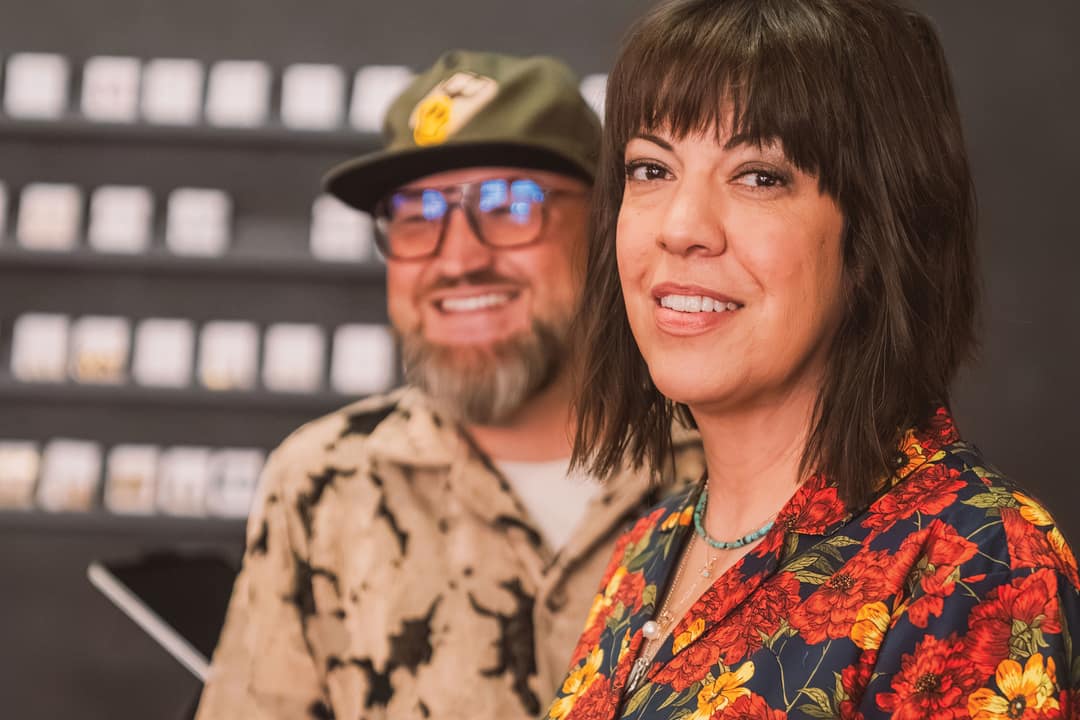
More than a year after a devastating fire left their downtown boutique in ruins, the moment felt like more than a comeback
- Words
- Laura Lorta
- Photos
- Ernest Bordon
- Read
- 5 min
- From the issue
- Issue 161
When Clay and Emily Ross reopened the doors to Yobel in April 2025, more than a year after a devastating fire left their downtown boutique in ruins, the moment felt like more than a comeback — it was a homecoming. Nearly 200 people gathered on a weekday afternoon, drawn not just by the promise of beautiful fashion and fine art but by the story behind the space: a journey of persistence, purpose, and a passion for people.
Long before ethical fashion became a cultural buzzword, the seed for Yobel was planted on a trip across the globe. In 2007, cofounders Sarah Ray and Donovan Kennedy were traveling internationally when they encountered a heartbreaking truth: people with extraordinary craftsmanship were trapped in cycles of poverty, unable to access fair markets. Their solution? A boutique founded on the belief that business can end poverty. In 2008, Yobel was born.
By 2017, Sarah Ray, now as the sole owner, thought she may be ready to step away, and she knew exactly who she wanted to carry the torch. Emily and Clay Ross, friends of Sarah’s and passionate advocates of ethical living, were newly married and already dreaming of a future that offered ethical, sustainable fashion from head to toe.
“We had a five-year plan to create a head-to-toe men’s and women’s fashion boutique,” Emily recalled. “More toward the fashion side because that’s where our passion is.”
They finalized the purchase of Yobel in early 2019 — just six months before the pandemic turned the world upside down.
Yobel’s original storefront was inside Ivywild School, a bustling community space in Colorado Springs. With COVID-19, the building closed, and Yobel lost access to its space. The Ross’ knew they had to move, and fast.
They found a new home downtown, a dream location that allowed them to expand their vision. There, Clay pitched a fresh idea. “Wouldn’t it be cool if you just looked up and there was art?” That spark became The Look Up Gallery, a rotating art installation high above the boutique’s merchandise. They debuted new artists every First Friday and quickly became an exciting part of the city’s creative scene.
But just as momentum was building, disaster struck again. In December 2023, a fire at a neighboring restaurant filled their space with soot and smoke. Nothing was salvageable — they lost everything.
“It was super, super devastating,” Emily said. “We had no idea what was going to happen.”
Emily’s journey into ethical fashion started long before she stepped into the business world. As a teen, she made her own dresses for homecoming and prom. In high school, she learned about the “ugly side” of fashion, with its ties to modern slavery and environmental harm, and imagined a future where she could buy out sweatshops and turn them into fair-trade factories.
“I thought I would just get filthy rich, buy all the sweatshops, make them good, and get really famous,” she joked. But instead of fashion design school, life took her into human resources, a career she maintained for 16 years.
During those years, she sewed, styled, and dreamed. So did Clay, whose background included everything from working with disabled adults to serving as a pastor. Their mutual love for fashion — and people — was the foundation that would later become Yobel’s guiding ethos. When Sarah Ray reached out to them about possibly taking over the business — while they were on their honeymoon of all times — they felt an instant connection.
When she and Clay bought Yobel, Emily initially worked part-time while still managing her human resources career remotely. But, eventually, the call of Yobel became impossible to ignore.
“Yobel became the only place I wanted to be,” she shared. By the end of 2022, she had phased out of her human resources position and made the leap, years ahead of schedule.
After losing their second storefront to the fire, the Ross’ began searching for a new location but nothing felt right. Throughout 2024, they viewed 23 spaces in total. “We felt like Goldilocks,” Emily said. “That one’s too big, that one’s too small, that one’s too far away.”
Just as they were about to take a break, they stepped into an old Comcast office in the historic Trolley Block on South Cascade Avenue. “We walked in and just freaked out,” Emily said. “We just knew it was the place. Now we say the 23rd time’s the charm.”
The space was perfect, with vaulted ceilings, exposed brick and iron and steeped in history. It allowed them to not just rebuild Yobel but to create everything they had ever dreamed of creating.
They held a soft reopening in December 2024 with just accessories, due to supply chain limitations, since most of their partners are made-to-order, small-batch producers. Then, on April 17, 2025, they reopened in full. “Pretty much every dream, idea or passion that my husband and I have had, independently and together, we’ve been able to execute in this space,” Emily said.
Today, Yobel includes a full boutique of ethical men’s and women’s fashion, an 18-member fine art gallery featuring local artists, seven art studios, including Clay’s, and a liquor license so customers can “sip and shop.”
The grand reopening had an overwhelming turnout. What Emily and Clay thought would be a middle-of-the day event for the press and their parents turned out to be a homecoming attended by 200 people. “We have had the most incredible welcome back,” Emily said.
This latest iteration of Yobel also sits at the heart of what Colorado Springs hopes will become its first true “live, work, play” neighborhood. The city has been actively developing the area into a walkable, urban lifestyle district — something that’s still rare in a region known for sprawling suburbs and scenic acreage. And Yobel isn’t just part of the neighborhood’s evolution; it’s helping lead it.
Throughout it all, Yobel’s mission has remained clear: “When people and the planet are a priority, we all profit.”
“Profit can be an ugly word,” Emily admitted. “But there are incredible companies, like TOMS, that are for-profit and have built their wealth without doing it on the backs of people. They don’t have to exploit people. There is enough to go around.” She went on to explain that most global companies could raise wages by just 1.5 to 2% and still thrive. “Everybody would have a livable wage, and the impact of less poverty in the world would be so incredibly positive for our globe that we would all benefit even more,” she said. Yobel’s model proves that beautiful, on-trend fashion doesn’t require cutting ethical corners.
“Our products speak for themselves — really cool jackets, blazers, earrings — and then you find out this is done right. Here’s why, and here’s how.”
They emphasize buying less but buying better, investing in long-lasting pieces made with care. “Save up, buy one really cool, fair trade, vegetable-tanned leather bag. You won’t be replacing it every six months because it’s falling apart.”
What makes Yobel special isn’t just the fashion, though their curated pieces are effortlessly stylish and built to last. It’s the message stitched into every jacket, earring, and leather bag: dignity matters. And shopping can be a force for good.
For Emily and Clay, fashion isn’t frivolous. It’s deeply human. They’ve built a space where each purchase supports global artisans, each garment keeps waste out of landfills and each customer walks away with more than just a new look, they walk away with a story.
Keep reading

Lifestyle
A New Era Of Self-Care
Nestled in the breathtaking landscape of The Garden of the Gods, Strata Spa and Salon offers more than just pampering—it provides a sanctuary for holistic wellness.
By Laura Lorta5 min read

Lifestyle
Community Champion
Community Champions: How James Proby is Changing Lives.
By Tiffany Wismer4 min read

Lifestyle
Reflecting Confidence
How Taylor Draper’s INHERENT Transforms Men’s Lives.
By Tiffany Wismer4 min read