

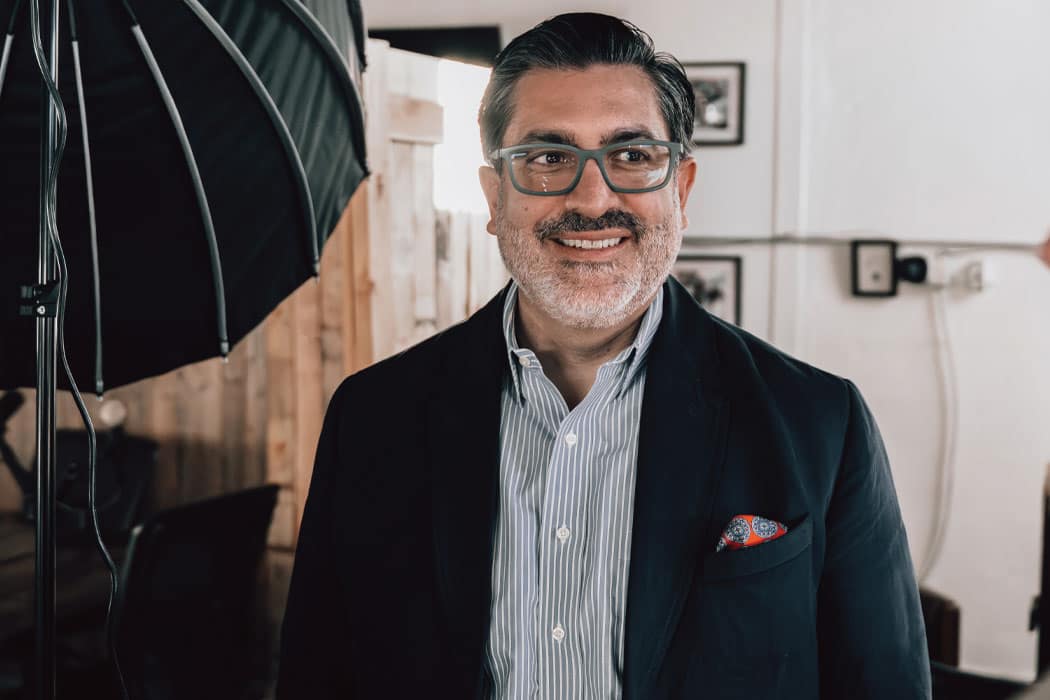
Jonathan A. Liebert is pushing himself and all of us forward towards the future of AI. From tool to thought partner, human and system must advance together despite the real risks and biases.
- Words
- Melanie Sue Hicks, PhD
- Photos
- Ernest Bordon
- Read
- 4 min
- From the issue
- Issue 163
When Jonathan Liebert says he’s not an AI expert, he says it with a grin that suggests he’s very comfortable being called something else, a translator. He’s translating artificial intelligence, this decade’s most misunderstood powerhouse, into practical advantage for small businesses, nonprofits and civic leaders across the Pikes Peak Region.
Liebert’s resume reads like a bridge between worlds. He spent 15 years in behavioral healthcare in Colorado Springs, the kind of work that trains you to listen for what people really mean. A decade ago, he crossed into commerce and became CEO of the Better Business Bureau of Southern Colorado. He also serves on the national BBB board and its AI Task Force. He also advises through the National Governors Association, where he was tapped to chair the first-ever AI & Quantum committee.
Translation: He’s everywhere AI meets real life.
Like many of us, Liebert’s first encounter with ChatGPT produced equal parts delight and suspicion. A friend showed him the app in 2024. It wrote a tidy three-minute speech on social entrepreneurship.
“It wasn’t in my voice,” he recalled, “but it was surprisingly competent.” He set it aside, came back and found the software had evolved. Fast. Soon he noticed something else evolving, his own thinking.
That observation became the spine of his forthcoming book, “Thought Partner,” which frames AI not as a mere tool but as a collaborator. The premise is disarmingly simple. The magic isn’t in the first 20% of work AI does for you, it’s in the next 80%: connecting dots, stress-testing assumption and revealing blind spots.
“People worry AI will make them dumber,” he said. “It can, if you let it replace your thinking. But writing a great prompt forces you to think clearly about the outcome you want. It’s Jeopardy in reverse. What question gets the answer you need? Used well, AI sharpens critical thinking.”
According to Liebert, 2024 was the year of generative AI, the era of prompts that produce text, images and video. 2025 is the year of agentic AI, systems that don’t just draft, but do. Give an agent a goal and it books the flight, drafts the proposal, populates the CRM or emails the customer. In other words, fewer copy-and-paste moments, more end-to-end outcomes.
He points to emerging AI browsers such as Perplexity’s Comet, or Atlas from OpenAI as well as “agent mode” inside leading chat tools. Anything a human can do on a website an agent can do if you allow it. It’s early, permission-gated and carries obvious security sensitivities. But the vector is clear.
Liebert is already piloting his own. “BEN,” short for Business Engagement Navigator, is a British-accented voice agent designed to call thousands of local businesses per month, invite them to free BBB AI classes and handle simple scheduling via text. Where does that go next? Customer service triage, simple sales funnels and calendar management. “The boring stuff,” he said, “so humans can do the human stuff.” His forecast: multi-agent systems will define 2026. Think less one clever chatbot, more a small team of bots with different roles, taking direction the way a project manager directs a crew.
There are obvious risks in this wild west of technology. Liebert doesn’t sugarcoat the warnings. He worries about misuse, scams, deepfakes, state actors and coordinated misinformation. He’s frank about the need for thoughtful guardrails and for leaders who actually understand the tech they’re regulating.
He also reframes the bias conversation. Yes, code can carry bias, and yes, the open internet is full of it.
“The hardest bias to fix,” he said, “is ours.” We all bring implicit bias to our prompts and our reviews of the results. Without intentionally asking AI to argue the other side, cite diverse sources, challenge our frames, we build exquisite echo chambers.
There’s also a broader uncomfortable truth. This industrial revolution flips the script. Historically, automation hit blue-collar jobs first. AI goes after the cognitive tier. Middle and high income degree-heavy roles are already feeling its impact. The I-25 corridor is primed, with a dense mix of tech firms and a growing quantum ecosystem. That’s exciting and urgent. “Don’t fear AI taking your job next year,” he warned. “Fear the human beside you who learns it faster, taking it tomorrow.”
For all the circuitry, Liebert is ultimately a psychologist at heart. He calls AI a “cognitive mirror,” amplifying what we put in. Feed it cynicism, it gets efficient at that. Feed it service, it scales that, too. He imagines a symbiosis between human judgment (soul) and machine capability (system). The question isn’t “Will the machines replace us?” It’s “What does it mean to be human in an era of thinking machines?”
One might ask why is the Better Business Bureau neck-deep in AI? Because trust is the BBB’s specialty.
“People are excited,” Liebert said, “and they’re scared.” In that climate, a trusted brand can open doors, vet vendors and teach responsible use at scale. Since January, the BBB of Southern Colorado has trained roughly 3,000 people on ethical, practical AI.
If you’re AI-curious but wonder where to start, Liebert offers a simple starter kit:
1. Take a class. There are excellent free options (including BBB workshops). 2. Download a reputable tool and play around. Keep sensitive data out. Build your comfort level. 3. Find a friend. Ask someone who’s a step ahead to show you how they put AI to use.
As Colorado Springs positions itself at the crossroads of innovation and integrity, leaders like Jonathan Liebert are proving that technology and trust can coexist. The city’s future won’t be defined by how quickly it adopts artificial intelligence but by how wisely it does. With a psychologist’s insight and a business leader’s pragmatism, Liebert is ensuring that when machines learn, humanity learns with them.
For More Information: aithoughtpartner.co
Keep reading
Profiles
A Clear Future for All
The same values that guided Joe Aldaz through each season of his life — from small town New Mexico to military service to leading the Hispanic Chamber of Commerce — continue to determine every step he takes today.
By Alyssa Shikles5 min read

Profiles
The Soldier Discovered His Song
I felt like if somebody was trying to stop or block our freedoms, then I had every right and honor and privilege of being able to fight them.
By Alyssa Shikles5 min read

Profiles
Defying Ranks. Rewriting The Rules.
When I was 3 years old, I told my mom I was going to be president of the United States.
By Linda DuVal6 min read