

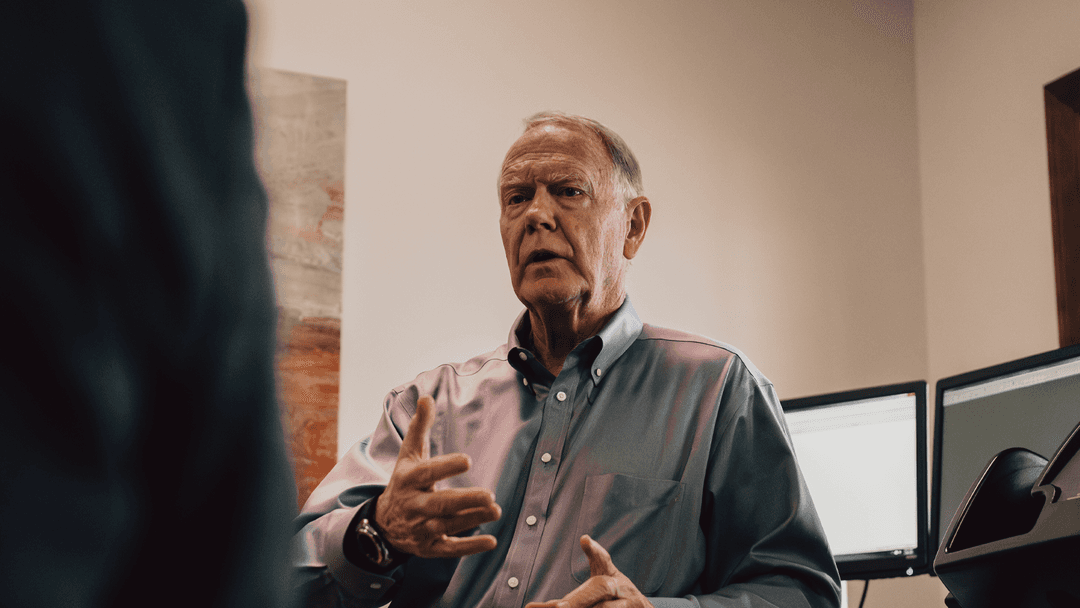
Patrick Szymankowski's blood pressure would spike, he got violently sick after he ate, and he was having migraines with auras, among other things. It was debilitating.
- Words
- Linda DuVal
- Photos
- Ernest Bordon
- Read
- 4 min
- From the issue
- Issue 160
Patrick Szymankowski didn’t know what on earth was wrong with him. He could describe it in one word: ill. In fact, very ill. His blood pressure would spike, he got violently sick after he ate, and he was having migraines with auras, among other things. It was debilitating.
A paramedic who served in the U.S. Army in Iraq, Patrick Szymankowsk knew 15 years ago that something was terribly wrong. He had left service in 2001, settled in Colorado Springs, and ultimately started his own independent insurance agency. Business thrived, but his physical health was declining.
He did not avail himself of medical help from the Veteran’s Administration because “I felt like there were soldiers with worse problems than mine who really needed them. I could afford my own health care.” But when the symptoms became unbearable, he went to a special clinic he knew about in Lubbock, Texas. They checked him out, gave him some medication and sent him home. “They did not really help. I was discouraged to say the least,” he said. “I guess I just accepted that I’d have to live with it.”
The physical symptoms were bad, “but the anxiety was debilitating,” he recalled. “I didn’t know what was wrong, and I could not seem to do anything about it.”
Enter Strata Med.
Cardiologist Michael J. Barber, M.D., retired from his traditional medical practice, frustrated with the compartmentalized medical approach to illness, the paperwork and dealing with insurance companies. He had a vision for a new kind of practice. First, though, he wanted to gain a little knowledge in related fields. “I trained in traditional medicine, but when I decided to change, I went back to Duke [University] and enrolled in their integrated medicine program.”
Located within the grounds of Garden of the Gods Resort and Club, Strata Med is a medical practice open to the public—welcoming locals, club members, resort guests, and area visitors. A second Strata Med location is on Ridgeline Drive.
The idea was that Strata Med would “combine the best of both traditional and nontraditional … Western med meets Eastern med … and treating patients with a more holistic approach.” This treatment approach incorporates both conventional medical treatments and complementary therapies such as acupuncture, massage, and herbal medicine. As a concierge direct primary care medical practice, Strata Med does not participate with traditional health insurance plans. A few local corporations and Kaiser Permanente offer services such as acupuncture and chiropractic care through Strata Med, however. Patients of Strata Med can receive single treatment services or become members of the practice. Memberships are tailored to each patient’s needs and vary in price accordingly. A VIP membership at Strata Med includes all of their services.
Dr. Barber and his partners envisioned a clinic where everything was under one roof. If a patient got a referral, it was just down the hall, not in another part of the city. “If you have high blood pressure, we can treat that. If you have a minor sports injury, we can treat that,” he said. “I think it eliminates confusion and inconvenience for the patient.” And, he added, “I can spend time taking care of people in a much more relaxed atmosphere.”
Patrick’s wife, Erica, was using the spa services at Strata and felt like it might be the answer to his health issues. He signed on for the full workup.
“I was miserable,” Patrick said. “I had heart issues and blood pressure spikes. You could see a vein throbbing in my neck. I would eat something and get ill. I’d see auras and get migraine headaches.”
“He was having blood pressure issues, wanted to lose weight and improve his energy. And his GI [gastrointestinal] issues were serious,” Dr. Barber recalled.
“They did stress tests, cardiac scans, everything, which showed nothing wrong,” Patrick said. “I did massage to relax, had acupuncture, and tried practicing a lot of wellness.”
After the fact-finding mission and seeing various doctors to address his various problems, it was decided that he needed to see a naturopath on staff to test for food sensitivities. “Dr. Barber and his crew suspected that I had been exposed to chemicals in Iraq that changed my body,” Patrick said.
His tests showed that he needed to avoid eating such things as beef, mushrooms, bananas, corn and rice, among other things. So he stopped. And after 30 days, “I felt normal again for the first time in 15 years. I have energy from the time I get up and until I go to bed.”
“The change is nothing short of miraculous,” he added. At 45, “I’ve got my life back.” Dr. Barber commented that “Patrick’s recovery was outstanding, but not unique among our patients.”
The Strata Med approach includes the services of 40 clinicians from all types of wellness services. Referrals are made outside the practice as needed. Every other week, there is a staff meeting of key personnel to discuss patient needs and internal referrals. As a result, “You have a lot of different eyes looking at each situation. You get multiple opinions … and it simplifies things for everyone, especially the patient.”
lt’s been a professional boon for Dr. Barber, too. “I am able to be a lot more engaged with my patients,” he said. “It’s probably extended my medical career for five or 10 years.”
The Strata Med approach has definitely worked well for Patrick.
“My blood pressure is back to normal. I’ve lost weight. I no longer have migraines. And I have energy,” he said. “I’ve learned to listen quietly to my body.” He’s no longer pre-diabetic and he takes no medications—just supplements for nutritional purposes.
“I’m very happy with their multi-practice approach and having access to different specialties that normally don’t integrate with most modern practices,” he said. Sure, he has to forego a lot of favorite foods, but he thinks it’s worth it.
“People ask me, ‘What do you miss?’ and I say, ‘What I don’t miss is being sick all the time.’”
Keep reading

Wellness
Wonder Woman
At 81, Bonnie Sumner hopes her achievement inspires others. But that’s not why she wanted to break a Guinness world record.
By Linda DuVal5 min read

Wellness
Back On The Ice
Naomi Williams' Journey of Resilience on the Road to the 2030 Olympics.
By Laura Lorta5 min read

Wellness
Advancing the Science & Art of Dentistry
From pediatrics to restorative dentistry, specialists explain how the dental profession continues to evolve to better serve Colorado Springs patients.
By Josh Skaggs5 min read